

Horatio Alger Jr. was a nineteenth-century American writer whose name became a stand-in for a certain kind of American success story: the poor boy who rises through hard work, honesty, and a lucky break. Between the late 1860s and his death in 1899, he wrote more than a hundred novels for young readers, most of them built around that same basic plot. Few people read his books today, but the phrase “a real Horatio Alger story” still gets used whenever someone climbs from poverty to comfort.
The strange part is that Alger himself never got rich from any of it, and the boys in his novels rarely become wealthy either. What he actually left behind is a lot more complicated than the myth that carries his name, and it includes a scandal his admirers spent decades trying to erase from the record.
A Strict Childhood Outside Boston
Alger was born on January 13, 1832, in Chelsea, Massachusetts, a town later absorbed into Revere. His father, Horatio Alger Sr., was a Unitarian minister who taught his son to read and write at home before he turned seven. The elder Alger ran a tight household, and by age nine the boy had already earned the nickname “Holy Horatio” for how closely he followed his father’s rules.
Money was tight. Alger’s father had lost savings speculating in the land boom of the 1830s and took up farming to make ends meet. That early instability, living respectably but without much cash, shows up again and again in the family situations Alger later gave his fictional heroes.
He attended Gates Academy and then entered Harvard University at sixteen. He did well there, studying under Henry Wadsworth Longfellow among others, and graduated in 1852 with Phi Beta Kappa honors, ranked eighth in his class.
Alger was small and slight as a boy, and biographers note he struggled at times with the more physical, rough-and-tumble side of school life among his peers. Writing came easier to him. He had pieces published in local newspapers while still a student at Gates Academy, years before anyone would have guessed he’d spend a career telling stories about boys unlike the sheltered, closely watched child he had actually been.
Harvard, the Ministry, and a Trip Abroad
After Harvard, Alger worked briefly as a schoolteacher and journalist before his father pushed him toward the pulpit. He enrolled at Harvard Divinity School in 1857 and finished in 1860. An unexpected inheritance let him delay the ministry and spend several months traveling through Europe instead, a rare stretch of freedom from his father’s supervision.
He returned to Massachusetts as the Civil War began, tried and failed to enlist, and was ordained in 1864. He took a position at the First Unitarian Church in Brewster, Massachusetts, the same year.
The Scandal That Ended His Ministry
Alger’s church career lasted only two years. In 1866, he was accused of sexual misconduct with two teenage boys in his Brewster congregation. Church officials removed him from the pulpit, and his father negotiated a quiet resolution: no criminal charges, in exchange for a promise that Alger would leave the ministry permanently and never work with children in a church setting again.
For more than a century, this episode was largely buried. Many of Alger’s personal papers were destroyed, and an early biography written decades after his death turned out to be fabricated, filling gaps in his life with invented, flattering stories. It took later historians, including Gary Scharnhorst and Jack Bales in their 1985 biography, to piece together what had actually happened in Brewster.
What makes the episode more unsettling is what came next. Alger left Massachusetts, moved to New York City, and built the rest of his career and reputation around close, ongoing contact with poor and homeless boys, the same population involved in the accusations against him.
New York, the Newsboys, and Ragged Dick
Alger settled in New York in 1866 and would call it home for most of the rest of his life. His first few novels there sold poorly. Looking for material, he began spending time at the Newsboys’ Lodging House on Fulton Street, a shelter for homeless newsboys and bootblacks run by Charles Loring Brace’s Children’s Aid Society.
He talked with the boys, watched how they lived, and borrowed real details for his fiction: actual street names, an actual system the lodging house used for the boys to save small amounts of money, even the names of real kids he knew, reworked into his characters.
That research became Ragged Dick, or Street Life in New York with the Boot-Blacks, published in 1867 and 1868. The novel follows a fourteen-year-old bootblack who rescues a drowning boy, gets noticed by the child’s wealthy father, and uses the opportunity to move from the street into steady, respectable clerical work. It was Alger’s first major hit and the book most responsible for the formula that followed him for the rest of his career.
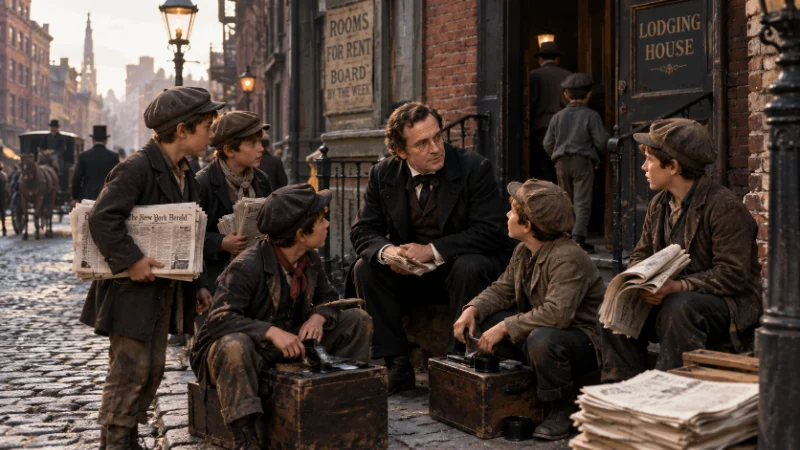
Alger worked real geography into the story on purpose. Dick’s world touches actual New York landmarks of the period, including the Bowery and Central Park, and several minor characters were drawn from boys Alger had met at the lodging house, their real names sometimes only lightly disguised. That grounding in observed street life is part of why the book read as believable to nineteenth-century audiences instead of landing as a simple morality tale with no roots in the real city.
The Alger Formula, and What It Actually Preached
Following Ragged Dick’s success, Alger wrote a six-book Ragged Dick series and then kept going, eventually producing roughly a hundred juvenile novels along with poetry, short stories, and a handful of biographies. He supplemented his book income by tutoring students, since novel writing for a juvenile audience paid modestly even when the books sold well.
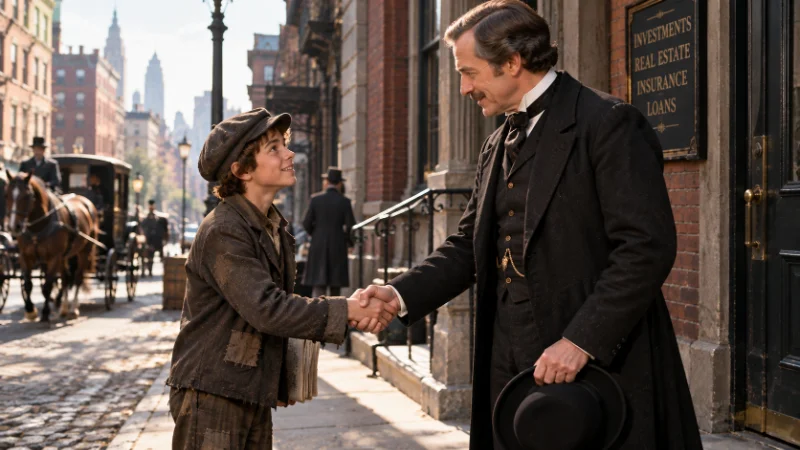
His plots repeat a recognizable pattern. An orphaned or poor teenage boy in a big city faces one setback after another, is tested by chance encounters, and eventually earns the notice of a wealthy adult through an act of honesty, courage, or diligence, not luck alone. The reward is rarely a fortune. It is usually a steady clerkship, a respectable trade, or a secure place in the middle class.
That distinction matters, because it cuts against the popular version of the “Horatio Alger myth.” Alger’s heroes preached honesty, thrift, and quiet respectability, not the pursuit of riches. His villains were frequently the wealthy themselves: bankers, lawyers, and landlords willing to foreclose on a struggling widow’s home. Historians studying his work generally agree that the modern idea of Alger as a prophet of getting rich through hustle is largely a twentieth-century invention layered onto stories that were really about earning a decent, honest place in society.
Critics of the day were rarely kind to the writing itself. Reviewers considered the plots repetitive and the prose plain, and Alger’s books were mostly ignored by literary circles even as young readers kept buying them by the thousands. That gap between critical reception and popular appetite is part of why Alger’s own name faded from serious literary conversation while the shorthand version of his stories kept circulating in newspapers, speeches, and everyday conversation about American opportunity.
1. How Alger Actually Worked
Most of Alger’s novels first ran as serials in boys’ magazines of the period, including titles like Student and Schoolmate and later story papers, before being collected and sold as standalone books. That serial format shaped his pacing: short chapters, a cliffhanger or small triumph near the end of each installment, and plain, direct sentences meant to be read quickly by a young audience rather than admired for style.
He worked at a steady, almost industrial clip, often producing several books a year across different series aimed at slightly different readers, from city bootblacks to farm boys heading west. That output helps explain both his commercial staying power and the criticism that his plots eventually blurred together, since the same basic sequence of hardship, honest effort, and a benefactor’s notice recurs with only the setting and trade changed from book to book.
Personal Life in New York
Alger never married and had no children of his own. According to biographers, he informally took in two street boys at different points and let them live with him in his New York apartment, continuing the same closeness to poor children that had ended his ministry years earlier.
He remained active in New York’s charitable circles, helping raise money for organizations that supported homeless and working children, including the Five Points Mission, the Children’s Aid Society, and the YMCA, alongside his continued support for the Newsboys’ Lodging House itself.
Financially, Alger lived comfortably but modestly by the standards of his own runaway success stories. Book royalties for juvenile fiction were thin even at strong sales volumes, and the tutoring work he took on to fill the gap suggests a working writer, not the kind of self-made fortune his characters eventually settled into. The contrast between his own steady, unglamorous income and the tidy financial rewards he handed his fictional boys is one of the sharper ironies of his career.
Death and a Legacy Built After He Was Gone
Alger’s health declined in the late 1890s, and he returned to Massachusetts to be near family. He died in Natick on July 18, 1899, at age sixty-seven. Newspaper obituaries at the time, including in the Boston Globe, estimated total sales of his books at around a million copies, a solid record but nowhere near the phenomenon he would become.
The real explosion happened after his death. Publishers reissued his novels in cheap editions, often trimmed and altered to fit changing tastes, and sales climbed into the tens of millions over the following decades. That posthumous wave is what cemented “Horatio Alger” as shorthand for self-made success in American speech, well past the point where most people had actually read one of his books.
His name lives on formally through the Horatio Alger Association of Distinguished Americans, founded in the twentieth century to honor people who overcame hardship to achieve success, and informally every time someone describes an underdog’s rise as “a real Horatio Alger story.” Few writers have had their name outlive their actual readership by quite this much, and few have had the private facts of their life stay hidden for quite so long before finally catching up with the myth.
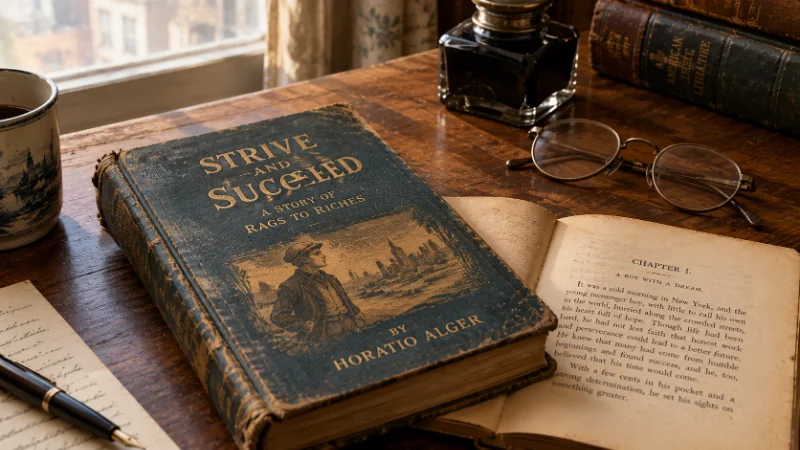
That combination is what makes Alger’s story worth revisiting rather than filing away as settled history. The public shorthand, a poor boy earning a fortune through pluck, is a simplified and largely inaccurate summary of books that were mostly about earning respectability, not riches. The private history, a minister removed from his pulpit over allegations involving boys, then spending decades in close, sustained contact with poor and homeless children, sits uneasily beside the wholesome image his name still carries in casual conversation. Both threads belong in any honest account of who Horatio Alger actually was, not just the one that made it into the catchphrase.